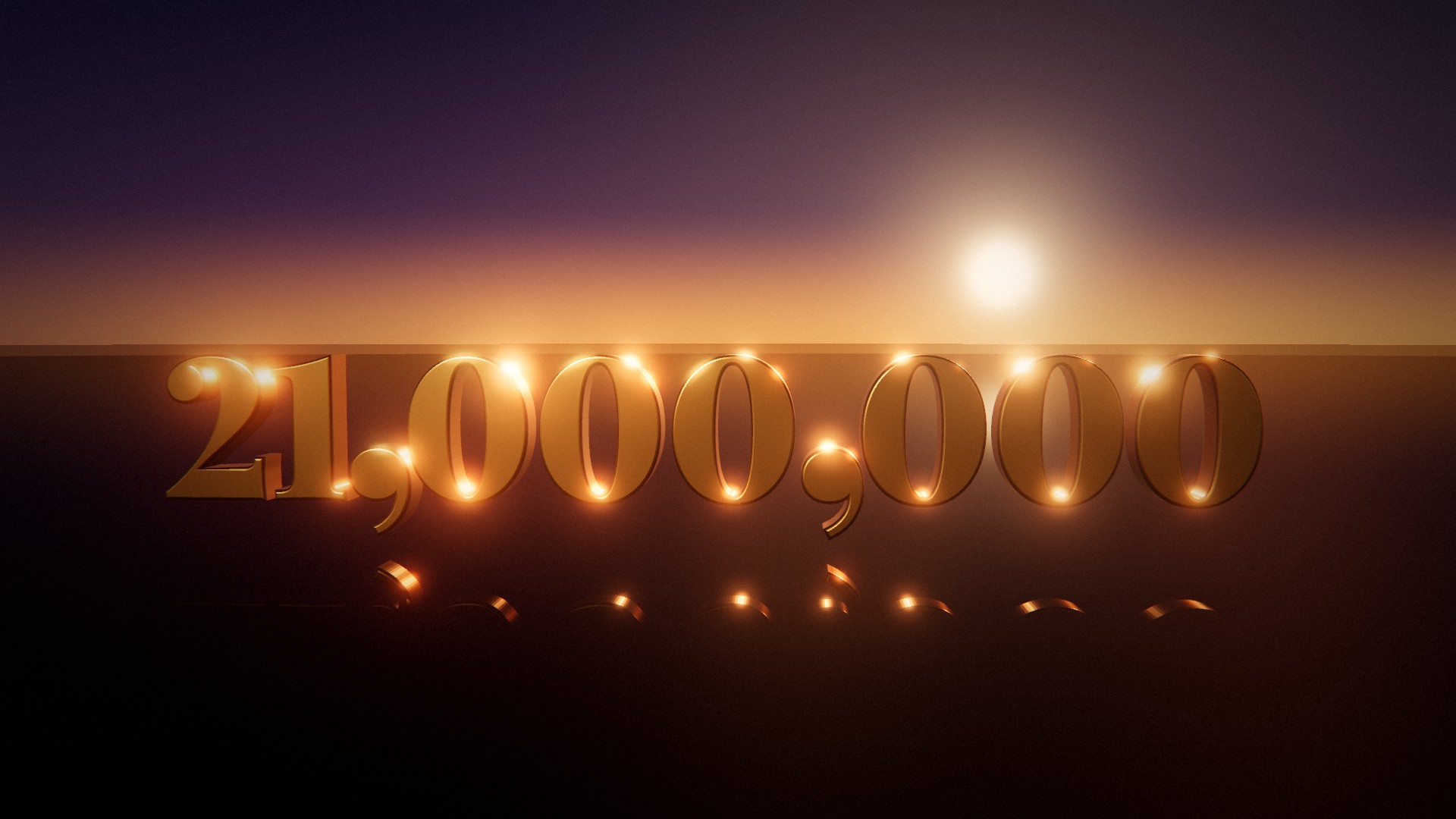
Money tells its own story: shell, stone, gold, paper, proof. Paper can be printed without limit. Proof has to be earned, and there will only ever be twenty-one million.
Every frame is a block
The film runs at 30 frames a second, and each frame is its own proof-of-work block: an 80-byte header that points to the block before it, commits to the SHA-256 fingerprint of the song, and carries a nonce that took real computing work to find. The first block points to Bitcoin's own genesis block. The strip along the bottom of the film shows the block you are watching; its leading zeros are the work.
- Blocks
- 5,521
- Hashes of work
- 1,444,915,378
- Difficulty
- 18 zero bits
It is an art chain, not Bitcoin, and it earns nothing. It shows the one thing a printer can't make: work you can check.
Print or prove
Printing costs nothing. Proof costs work. Try both.
0 notes
Paper money has no limit and no cost to make.
0 hashes
Your browser extends this film's chain from block 5,521, under the same rules as every frame.
Sovereignty simulator
Your freedom year
Set your bitcoin, what else you own and what your life costs. The simulator finds the first year you could stop working and still pay your way to 2050. The sooner that year, the higher your sun.
Prices, returns and four of the five strategies come from Bitcoin24, the open model by Michael Saylor, Shirish Jajodia and Chaitanya Jain. The rest is this simulator's own: the search for your freedom year, the years after it, the Double Dipper strategy, and the tax, borrowing and STRC choices.
- Net worth today
- Net worth in 2045
- Bitcoin price in 2045
- Bitcoin's share of world assets in 2045
- Bitcoin paid in tax through 2050
- Bitcoin still yours in 2050
OG Mode: borrow against your bitcoin, or swap some for STRC
From your freedom year, your costs come from shares, bonds and cash first, then from your bitcoin. Pick how your bitcoin pays its part. Each path shows the freedom year it gives you.
You sell bitcoin each year for what is left, and pay capital gains tax on each sale.
You borrow against your bitcoin instead of selling it. The interest adds to the loan, and a loan is not a sale, so no tax is due. If the loan reaches your cap, you sell enough bitcoin to bring it back down to the cap. That sale is taxed.
As bitcoin becomes a reserve asset, borrowing against it gets cheaper: the rate falls in a straight line to the mortgage rate (5%, under Assumptions) by 2050.
Your cap, as a share of your bitcoin's value.
The loan's share of your bitcoin's value at which the lender liquidates. The results show how far the price could fall, at your loan's riskiest point, before that happens. The model assumes the lender never calls the loan, changes its terms or fails.
In your freedom year you sell part of your bitcoin, pay the tax, and buy STRC, Strategy's variable-rate preferred stock, at its $100 stated amount. Its dividends pay your costs before anything else. If your bitcoin runs out, you sell STRC at $100.
12% was the rate in September 2026, up from 9% at launch in July 2025. Strategy sets it each month, and the dividend is not guaranteed. The model moves it in a straight line to the mortgage rate by 2050, as bitcoin-backed credit gets cheaper.
Strategy's filings expect its recent STRC dividends to be non-taxable returns of capital for US federal tax, up to what you paid for your STRC. The model assumes every dividend is treated that way until they have returned what you paid; after that, it taxes them as capital gains. That may not hold. Turn this off to tax every dividend as income, at the rate under Assumptions.
STRC's price moves. It fell to about $71 in the June 2026 selloff and was near $98.65, below its $100 stated amount, in late September 2026. The model holds it at $100 and assumes every dividend is paid.
Assumptions
Show the math, year by year
| Year | Bitcoin price | Your costs | Bitcoin bought (+) or sold (−) | Of that, sold for tax | Loan, and its share of your bitcoin | STRC dividend, after tax | Bitcoin left |
|---|
With the Bitcoin24 price model, bitcoin starts at your price today and grows at the model's rate for each calendar year. In the Base case that rate is 50% in 2025 and falls 2.5 points a year to a floor of 20%. Bear runs from 25% to 18%, falling 0.5 points a year. Bull runs from 75% to 25%, falling 5 points a year. Bitcoin24 stops at 2045. After that, the simulator lets bitcoin grow only as fast as the world's other assets, so its share stays at the 2045 level. The power-law model follows bitcoin's long-run trend (price ≈ 1.0117×10⁻¹⁷ × days since the genesis block, raised to the 5.82), scaled by your price path. Its trend price today is about . After 2045, in both models, bitcoin's yearly growth and your inflation ease toward 2%, the gap halving every 5 years, so neither compounds for ever (you can change this under Assumptions). Everything after 2045 is ours, not Saylor's. The plan ends in 2050: beyond it, too much will change for these numbers to mean much. Over that time bitcoin matures: loan rates and STRC's dividend fall in a straight line to the mortgage rate by 2050. The four-year cycle is ours too: at 0% bitcoin follows the smooth path; above it, bitcoin rises above the path every four years, falls the chosen share of its price the next year, and returns to the path, each fall 15% smaller than the last. Numbers in red are in a warning zone; the reason is listed under the results.
Your strategy acts today: it moves part of your shares, bonds and cash into bitcoin, and Double Maxi and Double Dipper also borrow against your real estate. Double Dipper puts half of what it moves, and half of your savings, into STRC instead of bitcoin. Your other assets grow at Bitcoin24's rates, with bond and cash yields taxed. Your mortgage grows at its rate and is never paid down. While you work, your pay covers your costs; if it does not, the gap comes out of your savings first, then out of what you own. From next year until your freedom year you invest what is left of your savings as your strategy says. The share you set under Save some in STRC buys STRC at $100, and STRC's dividends buy more STRC until you are free. From then on you stop earning and buying. Your costs rise at your inflation rate every year from today, so your first free year costs more than today's figure. Your real estate is never sold. What you own minus what you owe must stay above zero through 2050.
The freedom-year search, the years after it, Double Dipper, saving in STRC, and the tax, borrowing and STRC paths are this simulator's own additions to Bitcoin24. Sales use your average cost. A loan that reaches the lender's liquidation level ends the run. STRC facts: Strategy, SEC filing, June 2026, semi-monthly dividends, CoinDesk in June and September 2026. An illustration, not financial or tax advice. The simulator's code is on GitHub as a fork of Bitcoin24.
Bitcoin vs. the quantum machine
But what about quantum?
Everyone is asking whether quantum computers will break bitcoin. Here is the honest answer, in both directions. A quantum computer can't print the proof either: mining holds. The weak spot is keys that are already visible on the chain, and bitcoin has fixes in draft.
Open it full screen · The Construct is its own project, with every number sourced: code and sources on GitHub.
Made in the open
There is no video file on this page. The film is over fourteen thousand lines of JavaScript that draw each frame with three.js as the song plays, so the picture you see is being made on your own graphics chip. The same code, run frame by frame, renders the video file. The coins are photographed museum pieces, all public domain. The song was generated with ElevenLabs Music.